AI is not free.
Most people paying for AI, have no system for checking whether they are getting their money’s worth. They see a monthly charge, they assume they are getting value, and they move on.
I did this too, until I started paying attention to what I was doing in those sessions.
Here is what I found and three specific things I changed.

Tokens are the small chunks of text an AI model reads and writes, and they are what most subscription plans are charging you for behind the scenes. In April 2026, one AI company changed their tokenizer with no announcement and effective costs at the premium tier went up 12 to 35 percent, same subscription, you get fewer tokens per dollar. Someone on Insta called it AI shrinkflation. I’ve been deep in AI for a while, maybe I’m obsessed a teeny bit? I use AI every day at work and I’m a LinkedIn Top Voice for AI, one of a few in the country. Steal my three habits that fix this and the audit you should run this week.
How do I lower my monthly AI bill?
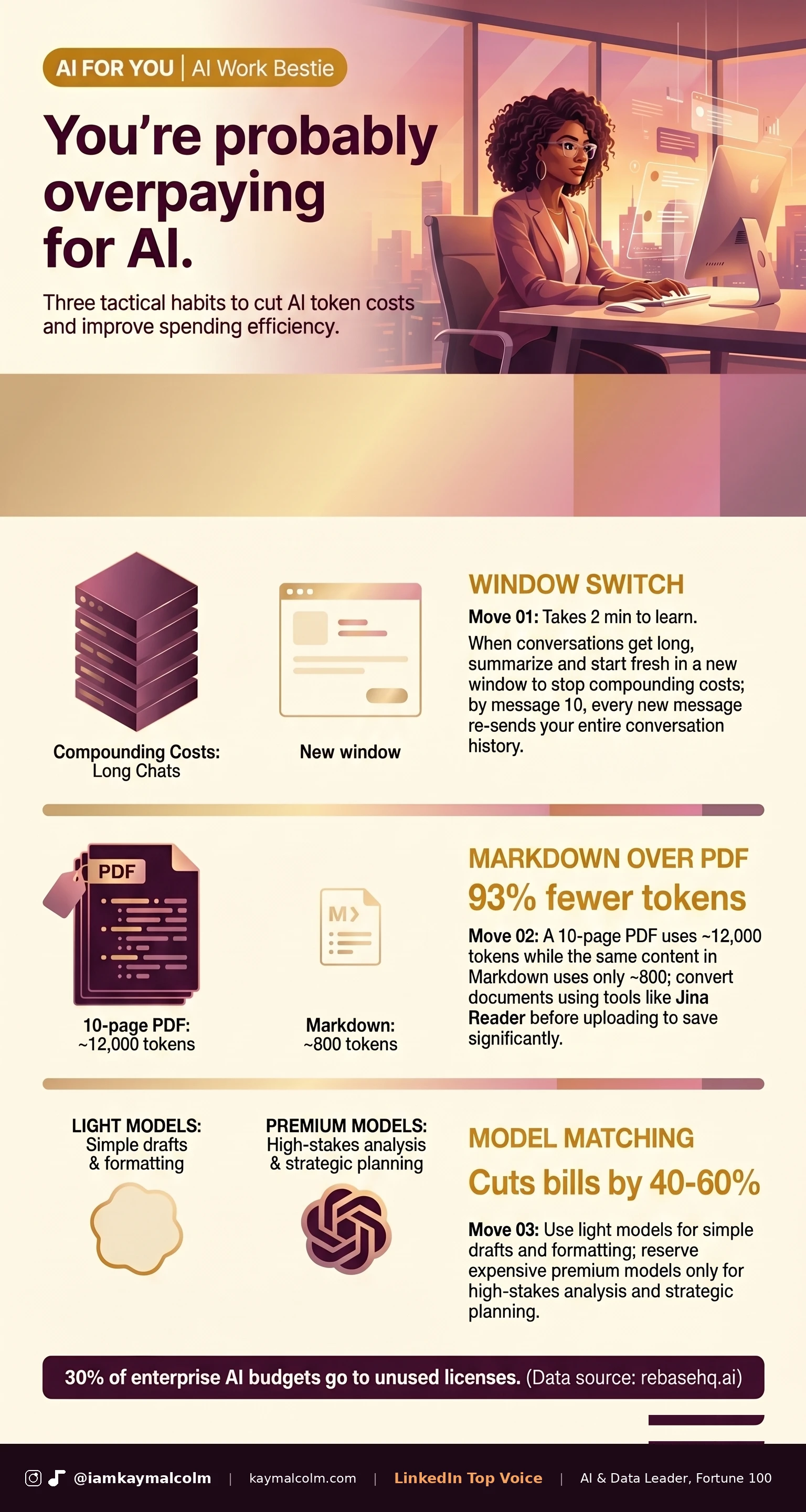
Three habits. Start a fresh window when a chat runs long, upload markdown instead of PDF, and match the model to the stakes. Then run the five-question audit below.
Move 01: Window Switch | Takes 2 min to learn, saves money every session
News flash: every message you send re-sends your entire conversation history. So by the 10th message, message 11 is carrying the token weight of everything that came before it. It exponentially compounds, that’s why the more you use AI (in a chat window)the worse it gets.
When a conversation gets long, stop and ask AI to summarize: “What did we decide, what was done, and what comes next?” Save that summary, open a new window, paste it as your first message, and start fresh.
Here’s the prompt I use:
Look at our full conversation history in this window and generate a session summary in the following markdown format. Be specific, include file paths, decisions made, exact values, and anything needed to fully resume with zero context from this window.

# Session Summary: [2-4 word title describing what was done]
**Date:** [today's date in YYYY-MM-DD format]

## What Was Done
Numbered list of every meaningful action taken this session. Be specific:
- file paths created, moved, or deleted
- code written or updated (include filenames)
- decisions made and what was decided
- status changes from/to
- tools configured or connected

## Current State
What is true right now that wasn't true at the start of the session.
Bullet points. Keep it scannable.

## Next Steps
What should happen next, pulled from context. Do not fabricate.

---
After generating the summary, tell me:
- I can safely close this window
- To resume in a new window, paste this summary and say: "Read this session summary and pick up where we left off."
I have this built as a workflow in my Claude Code AND Codex setup as well as in Claude Chat/ChatGPT, it’s called a window-switch skill and I use it every time a project conversation runs long or I do 5-6 rounds in a context window, whatever comes first. It is the single highest-impact habit change in this list.
Move 02: Markdown Over PDF | One step, 93% fewer tokens
A 10-page PDF uploaded to your AI uses roughly 12,000 tokens. The same content converted to markdown uses roughly 800 tokens. That is a 93% reduction for the same information.
If you upload reports, playbooks, or documents regularly:
Upload a PDF file and I will convert its full contents to clean, well-structured Markdown. I will:

Preserve all headings and convert them to the appropriate Markdown heading levels (#, ##, ###, etc.)
Format body text as readable paragraphs
Convert lists (bulleted or numbered) to Markdown list syntax
Represent tables using Markdown table format where possible
Preserve bold, italic, and other inline formatting
Include code blocks (```) for any code or preformatted text
Note images with descriptive placeholders like ![Image: description]
Maintain the logical reading order of the document
Do this once for your most-uploaded documents. In Claude I created it as an artifact so that my little mini app could do it automatically.

PDF Screenshot
The difference shows up immediately. (I did this for a 47-page playbook I upload constantly and felt a little embarrassed it took me this long to convert it.)
Move 03: Model Matching | The rule that cuts your bill without reducing quality
You do not need Claude Opus 4.8 or GPT-5.5 to draft a basic recap email.
The rule:
-If being wrong costs you nothing → use the cheap model (Claude Haiku, GPT-5.3Instant, Gemini Flash) -If being wrong costs you a conversation with your director → use the premium one (Claude Opus, GPT-5.5, Gemini Pro)
Most simple tasks (drafting, formatting, summarizing content you already gave it) go to the light model; analysis, strategic planning, and anything high-stakes goes to premium, which alone can cut your effective cost by 40-60% on daily usage. (I ran Opus for everything for the first few months before I started being intentional about this, and yes, the bill showed it.)
The 5-Question AI Cost Audit

Run this now, takes under 10 minutes:
1. What am I paying?
   (List every AI subscription: ChatGPT Plus, Claude Pro, Copilot, Gemini, etc.
   Monthly × 12 = annual spend.)

2. How often do I open each tool?
   (Daily = worth the subscription.
   Twice a week or less = re-evaluate.)

3. Am I using the features that require the paid tier?
   (Custom GPTs, Projects, advanced reasoning, Claude Code, or just the chat window?)

4. Is my company paying for a seat I rarely use?
   (30% of enterprise AI budgets go to unused licenses.
   Find out if your seat is pulling its weight.)

5. What's one task I repeat every week that I haven't tried automating?
   (That task is your highest-ROI AI experiment this month.)
This week, run the 5-question audit. It takes under 10 minutes and will show you where your AI money is going and which habit to change first. Pick the one habit from the three above that matches your biggest cost problem and implement it before your next AI session.
Come tell me on LinkedIn which one surprised you.
VP @ Oracle | LinkedIn Top Voice for AI | LinkedIn Learning Instructor | Views are my own
AI For You is a weekly newsletter for corporate women (and yes, the guys reading this too, welcome) navigating careers in the AI era. Real tools, real context, no tech background required.